








Riikonkoski Copper Gold Project

Riikonkoski (100% Taranis) covers a historic copper-gold deposit that was drilled extensively in the early 1970's by the Geological Survey of Finland. It is nearly identical to the ultramafic-dominated Ashaze-2 and Logatchev-1 Deposits currently forming on the Mid-Atlantic Rift several miles below the surface of the Atlantic Ocean.

 
Bright Ideas!

Illuminate

District Scale Exploration!

Recent News

NewNews

Recent News

Conventions and Trade Shows

RecentEvents

Conventions and Trade Shows

Drilling

72 drill holes (16,326 m)

The GTK has conducted extensive exploration on the deposit to a depth of 200 m below surface, and the deposit is drilled-off to NI-43-101 compliant spacing.

Geophysics

SkyTEM and GTK

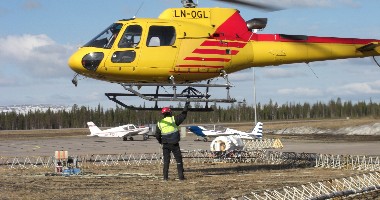
The GTK has completed a variety of ground geophysics over the deposit, and Taranis completed some test lines of SkyTEM helicopter EM over the deposit in hopes of gaining a better understanding of the geophysical response of the deposit.

Exploration Expenditures

Over US$ 7.6 Million (GTK) and $100K (Taranis)

Extensive diamond drilling has been completed on the Riikonkoski copper-gold deposit, and Taranis has systematically re-analyzed all of the drill core for gold content. All of the drill core is stored in Loppi Finland where it is accessible for future NI 43-101 review.

Riikonkoski Copper-Gold Project

Overview

The Riikonkoski Copper deposit, estimated to have 12.44 M tonnes of 0.52% copper by the Geological Survey of Finland (“GTK”) is an advanced-stage exploration project that has not seen any exploration conducted below 200 m depth. Outside of the Kittilä Gold Mine, this was the second largest exploration effort completed by the GTK in Lapland. Riikonkoski has an existing Resource, and this is classified as a "Historical Resource" under NI 43-101 guidelines.

Zone

% Copper

Tonnes

Itämalmi

0.48

9,560,000

Läntinen

0.68

2,450,000

Kangas

0.45

430,000

Total

0.52

12,440,000

Source – GTK Report M-19/2734/-72/1/10

The deposit was discovered and explored in the 1960’s and 70’s by the GTK as potential feed for the Outokumpu Mine in southeast Finland when copper was trading at US$0.59/lb, and the Outokumpu deposit was almost exhausted. Unfortunately, only grades in excess of 3% copper were economic at the time, and exploration was not continued at Riikonkoski. Advances in mining, particularly block panel caving and higher copper prices make Riikonkoski very attractive, not to mention its proximity (6.5 km to the southeast) to Naakenavaara that lies in the same geological formation.

16,326 meters in 72 holes were completed by the GTK (1970 to 1974) and identified four bodies of copper and gold mineralization, NI 43-101 spacing compliant. These bodies are hosted by altered sediments and tuffaceous rocks very similar to to Naakenavaara.

The presence of gold at Riikonkoski was not investigated by the previous operator, although selected sampling of only 2% of the core by the GTK did yield values greater than two grams gold/tonne, the best interval being 2.13 meters grading 10.97 grams gold/tonne.

Taranis has conducted a comprehensive geological study of the deposit, and it bears a striking resemblance to modern sea-floor deposits that are found in the Mid-Atlantic Ridge at Logatchev, particularly the Ashaz-2 and Logatchev-1 vent fields. These deposits form over active rifts, and in the case of Naakenavaara are dominated by ultramafic volcanic rocks that have extensive sediment cover and are intruded by albite dykes and intrusions. The importance attached with this recognition is that these deposits tend to be large and laterally extensive, and are prone to having high-grade portions located proximal to the areas of hydrothermal venting.

Taranis has filed the Mining Claim applications over the deposit, and is awaiting the approval of the Mining Claims by the Finnish Government.



Welcome
Welcome
image1 image2 image3 image4 image5 image6

Gold

Gold is found in ores made up of rock with very small or microscopic particles of gold. This gold ore is often found together with quartz or sulfide minerals such as Fool's Gold, which is a pyrite. Gold's atomic number of 79 makes it one of the higher atomic number elements which occur naturally. Like all elements with atomic numbers larger than iron, gold is thought to have been formed from a supernova nucleosynthesis process.

Silver

Silver has been used for thousands of years for ornaments and utensils, for trade, and as the basis for many monetary systems. Its value as a precious metal was long considered second only to gold. The word "silver" appears in Anglo-Saxon in various spellings such as seolfor and siolfor. During World War II, the short supply of copper led to the substitution of silver in many industrial applications.

Copper

Copper has been in use at least 10,000 years, but more than 95% of all copper ever mined and smelted has been extracted since 1900. As with many natural resources, the total amount of copper on Earth is vast (around 1014 tons just in the top kilometer of Earth's crust, or about 5 million years worth at the current rate of extraction). However, only a tiny fraction of these reserves is economically viable, given present-day prices and technologies

Cobalt

Cobalt occurs in copper and nickel minerals and in combination with sulfur and arsenic in the sulfidic cobaltite (CoAsS), safflorite (CoAs2) and skutterudite (CoAs3) minerals. The mineral cattierite is similar to pyrite and occurs together with vaesite in the copper deposits of the Katanga Province. Cobalt is not found as a native metal but is mainly obtained as a by-product of nickel and copper mining activities.

Lead

Roman lead pipes often bore the insignia of Roman emperors. Lead plumbing in the Latin West may have been continued beyond the age of Theoderic the Great into the medieval period. Many Roman "pigs" (ingots) of lead figure in Derbyshire lead mining history and in the history of the industry in other English centers. The Romans also used lead in molten form to secure iron pins that held together large limestone blocks in buildings.

Zinc

Various isolated examples of the use of impure zinc in ancient times have been discovered. A possibly prehistoric statuette containing 87.5% zinc was found in a Dacian archaeological site in Transylvania (modern Romania). Ornaments made of alloys that contain 80–90% zinc with lead, iron, antimony, and other metals making up the remainder, have been found that are 2500 years old.

Welcome
themed object
We're Making BIG Things Happen in Finland!
Bookmark and Share
get in touch
back to top

These Websites have information that are interesting places to explore!

Geological Survey of Finland / Download Adobe Reader / Toronto Stock Exchange ("TMX") / Sedar / Kitco Metal Prices